

Before you hit "Publish", read it again: why European Portuguese proofreading matters
A spellchecker is not a proofreader. Nor is it hitting "Publish" and hoping for the best.
We have more tools to help us write than ever before. Spellcheckers catch typos. Grammar checkers flag potential problems. AI can rewrite a paragraph in seconds. But when content is intended for a particular audience, technology alone cannot replace linguistic judgement.
All it takes is to open a website, a restaurant menu or a social media feed. Sooner or later, you'll come across a typo, a missing word, an awkward sentence or something that doesn't sound right.
Sometimes, the explanation is obvious: nobody checked.
But even when someone did run a spellcheck, issues can slip through. That is because checking a text is not the same as reading it.
A spellchecker only knows what it knows
It is useful; it can catch many spelling mistakes quickly, and there is no good reason not to use one. However, it has limitations.
It may not flag a word that is spelt correctly but used incorrectly.
It cannot always tell when a sentence is ambiguous, awkward, or unnecessarily complicated.
It will not necessarily notice a missing word if the resulting sentence remains technically possible.
It cannot decide whether a piece of copy sounds natural, appropriate, or convincing.
For these examples, I've used a few mistakes I've come across online. Mind you, this is not something I do just to criticise; I gather them for learning purposes, such as using them as examples in this blog.
EXAMPLE 1: straightforward European Portuguese spelling or typing mistakes that a spellchecker would probably catch
It can happen to anyone. Maybe you forgot your glasses at home and thought you'd read the word correctly. Perhaps you relied on your device's predictive text, or you were simply convinced you knew how to spell a particular word.
Sometimes, all it takes is too much confidence and too little attention to produce results like this:
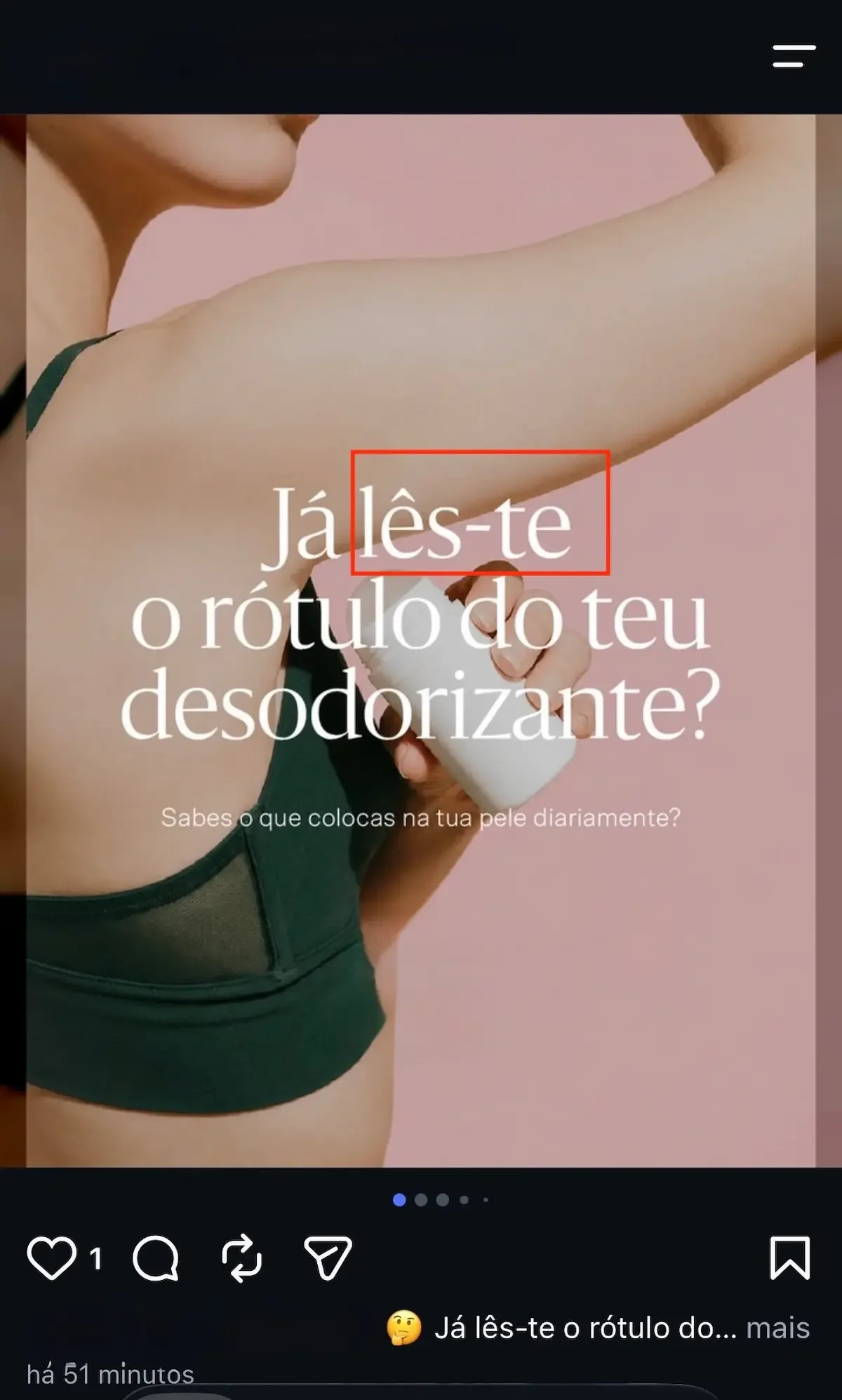
😩 Incorrect version: Já lês-te o rótulo do teu desodorizante?
😊 Correct version: Já leste o rótulo do teu desodorizante?

😩 Incorrect version: Ja encomendas-te o teu ovo?
😊 Correct version: Já encomendaste o teu ovo?

😩 Incorrect version: hoje às nossas lojas estão encerrandas!
😊 Correct version: Hoje as nossas lojas estão encerradas!
Now consider a sentence with no obvious spelling mistakes, yet it still sounds awkward or could be improved. This is the type of issue that professional European Portuguese proofreading can catch, but automated tools can overlook.
EXAMPLE 2: grammatically possible sentences or words that require human judgement in European Portuguese
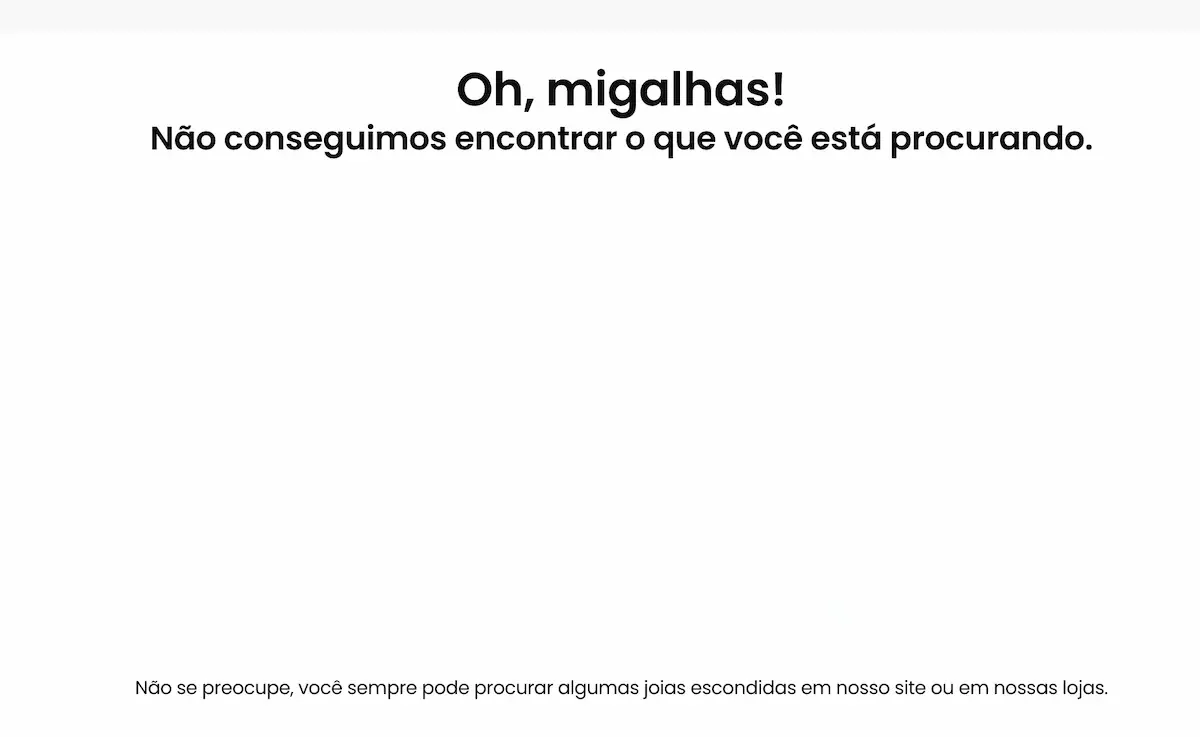
🏴 EN:
Oh, crumbs! We couldn't find what you are looking for.
This expression is unlikely to feel natural or immediately meaningful to a European Portuguese audience. It sounds odd because it immediately brings literal crumbs to mind and does little to convey the intended sense of frustration.
This is precisely where the European Portuguese message needs to make sense culturally and linguistically for its intended audience.
"Oh, crumbs!" is a British English expression that is a possible equivalent to Ora bolas! or even Oh, não! in European Portuguese.
The important thing here is that the meaning only becomes clear when you consider the message as a whole, particularly the second sentence, which tells us that the page or product could not be found.
😊 Correct, improved version: Ora bolas! Não conseguimos encontrar o que procuras. Não te preocupes, podes sempre procurar outros tesouros escondidos no nosso site ou nas nossas lojas.
In a previous post, I've already spoken about the confusion that Brazilian Portuguese can cause for a European Portuguese audience, particularly when content is intended for the Portuguese market, so I will not go into that again here.
I keep these images as little language treasures because there's always something to learn from and improve when coming across examples like these.
In this case, what we learnt is that there may be nothing for the spellchecker to flag. However, a human reader might still ask: does this sound natural? Is something redundant? Could the sentence be clearer? Does it suit the context and the intended audience? Or is it a complete disaster?
These pictures were taken during a holiday in the Algarve, where everyone clearly does their best to be bilingual, but sometimes fails miserably. It is also a good reminder that translation is not simply a matter of replacing English words with Portuguese words, and vice versa.
We deserve points for trying to be understood by foreigners, of course. However, even though we do try our best, it may only work to a certain extent.
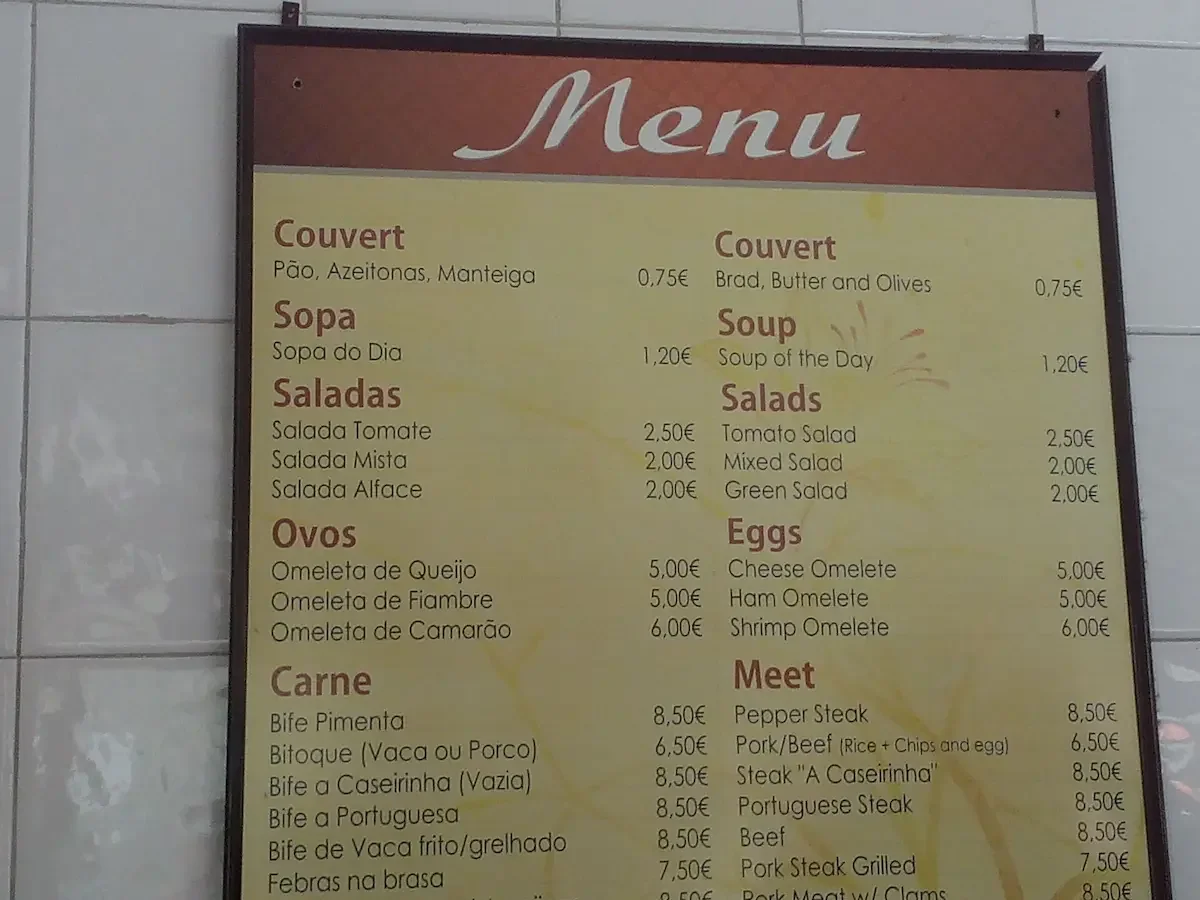
As you can see, in this menu, a spellcheck wouldn't flag a word such as "Brad", because it's a proper noun and it's written correctly. However, the problem is that "Brad" shouldn’t be in a menu; "bread" should. Therefore, "Brad" is a correctly spelt, but contextually wrong word.
Regarding "meet", it is a homophone of "meat", which a non-native may confuse, and a spellchecker may not flag.
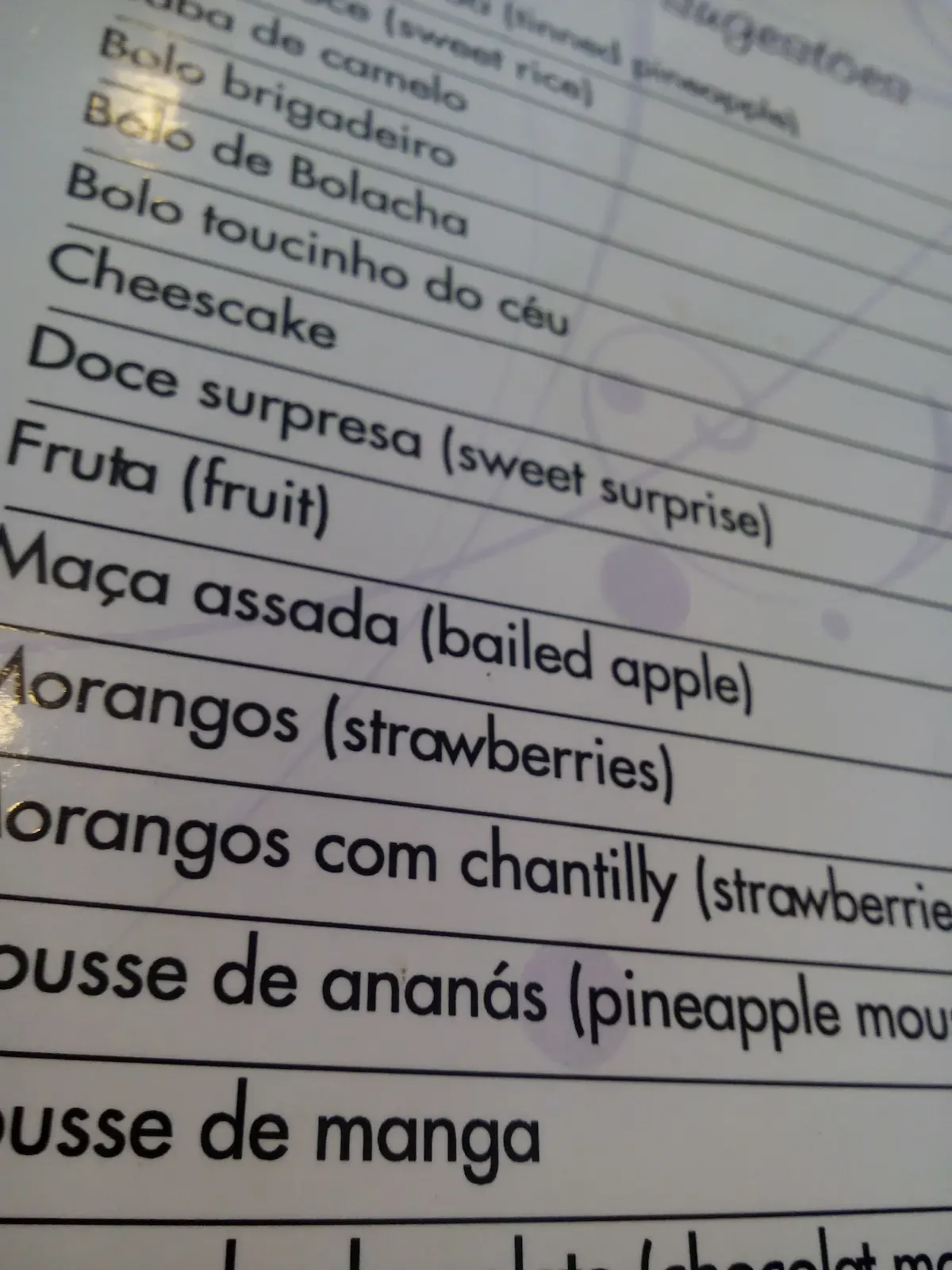
Clearly, whoever had a go at translating this menu gave up when they reached the word bolo (cake) and all its variants, which is a shame.
And literal translation didn't help either. "Sweet surprise", for instance, does not convey the intended meaning of "surprise dessert".
These "surprises" ended up leaving a bitter taste in my mouth rather than providing accurate descriptions and giving the menu an appealing touch. Such a shame! Algarvian desserts are incredible and deserve better.
A professional translator or localisation specialist considers the intended meaning, context and audience rather than simply translating individual words.
The case of the “bailed apple” made me laugh out loud. Forgive me, but this is both a linguist’s nightmare and their playground. Naturally, it got me wondering: what on earth could an apple have done to end up in jail, only to be bailed out? (The correct word would, of course, be “baked” apple.)
European Portuguese proofreading is more than finding typos
Proofreading is not simply the human version of spellcheck.
Professional proofreaders look at the text as a whole and check whether it is accurate, consistent, and fit for its purpose.
Depending on the project, that can include spelling, grammar, punctuation, terminology, consistency and obvious problems with wording or formatting.
Moreover, context matters enormously.
A sentence that works perfectly well in an internal email may be completely wrong for a website.
A phrase that is appropriate in a technical context may sound painfully formal in a social media post.
A grammatically correct translation may still sound unnatural to its intended audience. This is one of the key differences between straightforward translation and high-quality European Portuguese localisation.
This is particularly important for translated and localised content. A text can be correct and still not feel right.
Then there is the bigger problem: nobody checks it
Perhaps the most baffling thing is not that people rely too heavily on spellcheckers, but that some content appears to be published without being checked at all.
A typo in a private message is one thing. A typo on a company's homepage, in a newsletter sent to thousands of subscribers or in a paid advertising campaign is another.
For international brands publishing content in European Portuguese, this final quality check can make the difference between copy that feels translated and content that feels genuinely written for the Portuguese market.
Every piece of public-facing content says something about the organisation behind it. That does not mean one typo will destroy the credibility of a brand or business. People make mistakes, and everyone deserves some tolerance for the occasional slip.
However, repeated errors, careless writing and awkward copy can create an impression of inattentiveness.
If a company is asking customers to trust its expertise, products or services, that is an impression worth avoiding.
Read it again. Then read it differently
One of the simplest ways to catch problems is also one of the easiest to skip: stop looking at the text as its author and read it as its audience.
Does the sentence actually say what you intended?
Does anything sound unnatural?
Is there a word missing?
Is the punctuation helping or getting in the way?
Would you understand the message immediately if you knew nothing about the company?
Would this sound natural to a European Portuguese reader?
And, perhaps most importantly:
Does this sound like something a real person would actually say?
Tip: Reading a text aloud can also reveal issues that are almost invisible on screen. Your eye can become remarkably good at filling in missing words and correcting familiar sentences automatically. Your ear is often less forgiving. So give your text a listen.
Not everything needs a professional proofreader
Of course, not every two-line social media post needs to pass through the hands of a professional proofreader.
But if a text matters to your business, it deserves more than a quick spellcheck and a hopeful click on "Publish". This is particularly true for translated or localised website content, landing pages, product descriptions, and marketing campaigns targeting Portugal.
All of these represent your business in the same way that its visual identity does. You would not send a brochure to print without checking whether the company logo is in the right place, would you? Your words deserve the same attention.
Check yourself before you wreck yourself
And if the text really matters, get someone else to read it too. Even better, work with a professional European Portuguese linguist who understands your audience, your message and the cultural context in which your content will appear.
Ultimately, a spellchecker can tell you that a word might be wrong, but the responsibility for what you are trying to say is yours, and yours alone. When your words matter, a spellchecker is a useful first step, but shouldn't be the last one.